Bulk coconut oil purchases rarely fail because of price. They fail at the packaging stage—when a flexibag arrives at a facility that cannot heat or pump it, or when a buyer discovers that drum storage and handling costs more than the oil saved.
Coconut oil thickens around 25°C and hardens at lower temperatures. That single fact makes packaging a technical decision, not just a purchasing one. This guide compares the three main bulk formats—flexibags, steel drums and IBC/ISO tanks—and explains how to match packaging to your receiving facility.
Why Temperature Comes First
Coconut oil sets solid in whatever container holds it. None of the bulk formats melt it back out on their own.
Industry practice (Codex CXC 36-1987) recommends:
– Storage and shipment: 27–32°C
– Loading and discharge: 40–45°C in standard climates, 30–39°C in warm climates
– Maximum heating rate: 5°C per 24 hours
A cargo that lands cold cannot be flash-heated without risking scorching and discolouration. The packaging choice therefore determines who bears the reheating burden and how long discharge takes.
Flexibags: The Bulk Liquid Workhorse
A flexibag is a single-use, food-grade polyethylene bladder fitted inside a standard 20-foot container.
Capacity: 20–22 MT per container, with a capped maximum of 24,000 litres and 24,000 kg.
Advantages:
– Lowest logistics cost per tonne—roughly USD 82–110/MT all-in, against USD 150–200/MT for drums.
– Highest payload per container.
– Very low contamination risk: the oil contacts only the food-grade liner, and single use eliminates cross-batch contamination.
– One container, one customs unit, one pump-out operation.
Limitations:
– The buyer needs a bulk tank, pump and piping at destination.
– All-or-nothing delivery—no partial drawdown.
– Reheating requires a heating pad under the bladder and a steam or hot water source at the receiver.
– One oil type per container.
Flexibags suit high-volume industrial buyers with bulk discharge infrastructure. They are a poor fit for buyers without it.
Steel Drums: Flexibility and Traceability
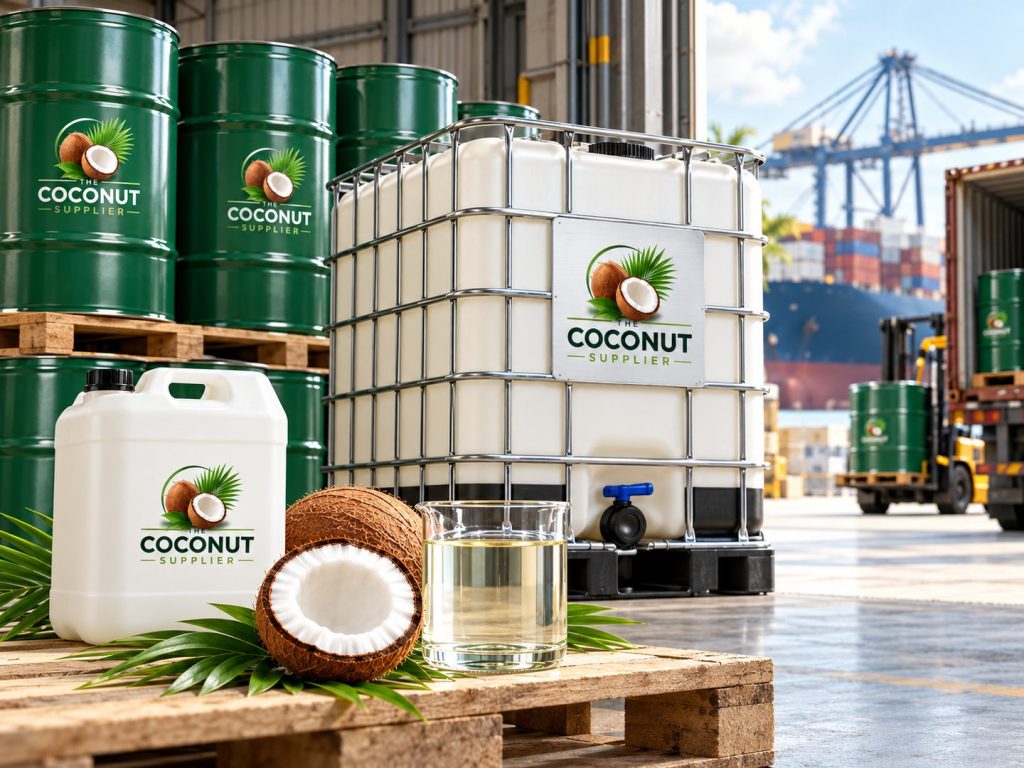
Steel drums—typically 190 kg or 200 litres—are the standard format where buyers need lot-level traceability or segmented heating.
Capacity: Up to 98 drums of 190 kg per 20-foot container, giving about 18.6 MT net. A 200-litre configuration loads around 80 drums, giving about 14.7 MT.
Advantages:
– Segmented heating. Each drum can be melted independently in a hot room or with a band heater—decisive in cold climates.
– Lot-level traceability. Individual drums can be marked and tracked.
– No bulk receiving infrastructure needed. Standard warehouse equipment is sufficient.
– Flexible offtake. Buyers can draw down inventory in smaller amounts.
Limitations:
– Higher cost per tonne—both packaging and freight.
– More handling labour and packaging waste.
– Medium contamination risk: reconditioned drums should be avoided for edible oil.
Drum specification: For edible oil, specify lacquered new steel drums with food-grade internal lacquer. Epoxy-lined drums also offer good oxidation protection. Un-lined plain steel drums are not suitable because of iron contamination risk.
IBCs and ISO Tanks: The Middle Options
IBC totes hold about 900–1,000 litres, with roughly 18 MT per 20-foot container. They suit mid-size manufacturers needing more flexibility than a flexibag but less handling than drums. Note that IBCs have no built-in heating pad and no standard reheating method.
ISO tanks carry about 20–21.5 MT and are reusable, with cleaning and return costs attached. They suit plants with heated discharge capability and buyers who value containment and temperature control.
Side-by-Side Comparison
| Format | Payload per 20-ft | Cost (indicative) | Contamination risk | Best-fit buyer |
| Flexibag | 20–22 MT | ~USD 82–110/MT | Very low | High-volume buyer with bulk discharge infrastructure |
| Steel drums | 15–18.6 MT | ~USD 150–200/MT | Medium | Distributor or buyer needing lot traceability |
| IBC tote | ~18 MT | Between flexibag and drum | Low–medium | Mid-size manufacturer |
| ISO tank | 20–21.5 MT | Reusable; cleaning and return costs | Low | Plant with heated discharge capability |
Shipping and Incoterms
Bulk coconut oil moves by ocean freight in full container loads. The packaging format sets the container count and therefore the freight cost per tonne: one flexibag is one container, while drums require more containers for the same tonnage.
The Incoterm matters here. Under **FOB**, the buyer controls carrier selection and can specify heating capability or a route that limits cold exposure. Under **CIF**, the seller selects the carrier, reducing the buyer’s control over transit conditions.
Indonesian exports require the standard document set regardless of packaging: Commercial Invoice, Packing List, Bill of Lading, Certificate of Origin and the Indonesian Export Declaration (PEB), plus MSDS, Certificate of Analysis, Halal and phytosanitary certificates as required by the destination market.
Practical Checklist for Buyers
- Start from the receiving facility, not the FOB price. Confirm whether the destination has a bulk tank and pump for flexibags, a hot room for drums, or heated discharge for ISO tanks.
- Confirm heating responsibility in the contract. Flexibag reheating needs a pad and a heat source at the receiver. Drum reheating is unit-by-unit. Reflect the 5°C per 24 hours maximum heating rate in the discharge plan.
- Specify the drum lining. Lacquered new drums with food-grade lacquer for edible oil. Reconditioned drums only for crude coconut oil or CFAD where the process tolerates them.
- Model cost per tonne, not per unit. Flexibags are cheaper—but only if the buyer has the infrastructure. Pump rental, heating installation and demurrage can erase the gap.
- Match packaging to offtake size. If you cannot absorb 20–22 MT in one run, drums or IBCs may be operationally better despite the higher unit cost.
- Verify flexibag certification. Require an ISO 9001 manufacturer and confirmation that the liner is FDA/EC food-contact compliant. This is product safety, not paperwork.
- Plan for cold-climate destinations. Specify bottom heating pads, confirm receiver heating capacity and build discharge time into demurrage calculations.
Frequently Asked Questions
What is the most cost-effective way to ship bulk coconut oil?
Flexibags, at roughly USD 82–110/MT all-in versus USD 150–200/MT for drums—provided the receiver has a bulk tank, pump and heating capability. Without that infrastructure, the saving can be consumed by pump rental, heating and demurrage.
At what temperature does coconut oil solidify?
It starts to thicken around 25°C and hardens between about 21°C and 14°C. Store and ship at 27–32°C, load and discharge at 40–45°C, and heat at no more than 5°C per 24 hours.
How many tonnes does a flexibag hold?
20–22 MT per 20-foot container, with a maximum of 24,000 litres and 24,000 kg.
How many drums fit in a 20-foot container?
Up to 98 drums of 190 kg, giving about 18.6 MT net. A 200-litre configuration loads about 80 drums, or 14.7 MT.
Which format allows partial discharge?
Steel drums. Each drum can be melted and discharged independently. A flexibag must be discharged in a single operation.
What drum specification is required for edible coconut oil?
Lacquered new steel drums with food-grade internal lacquer. Un-lined plain steel drums risk iron contamination and are not suitable.
Conclusion
Bulk coconut oil packaging is not a choice between three interchangeable formats. It is a decision about payload economics, contamination risk, traceability and who bears the cost of reheating a solidified cargo.
Flexibags offer the lowest cost per tonne and highest payload—but only for buyers equipped to receive bulk liquid. Drums cost more but provide segmented heating and lot traceability. IBCs and ISO tanks sit in between.
Choose from the receiving facility backward, not from the FOB price forward. Confirm heating responsibility in the contract, specify packaging correctly, and calculate cost per tonne including discharge.
PT Bonanza Megah is an established Indonesian coconut oil manufacturer with a history dating back to 1972, supplying coconut oil and specialty fats to international markets. The company offers flexibag, steel drum and IBC packaging options for crude and RBD coconut oil, with certification including GACC, Halal, ISO 9001, FSSC, FDA, Kosher and GMP.
Looking for a reliable coconut oil manufacturer and supplier from Indonesia? Contact PT Bonanza Megah to discuss your product requirements and bulk supply inquiries.