Coconut oil does not begin at a refinery gate or a flexitank loading bay. It begins with a smallholder harvesting nuts on a fragmented plot, drying kernels into copra, and selling into a chain of collectors and crushers whose economics determine whether that copra becomes export-grade oil—or leaves the country as a whole coconut. Understanding that chain is a procurement advantage, because the risks that materialise at the port usually originate long before the port.
This guide maps the coconut oil supply chain from copra production through crushing, refining, packaging and international distribution. It focuses on the structural features that affect supply security, quality consistency and landed cost—particularly in Indonesia, the world’s second-largest coconut oil exporter and a market where smallholder fragmentation and domestic policy shape export availability.
Copra Production: The First and Most Fragmented Link
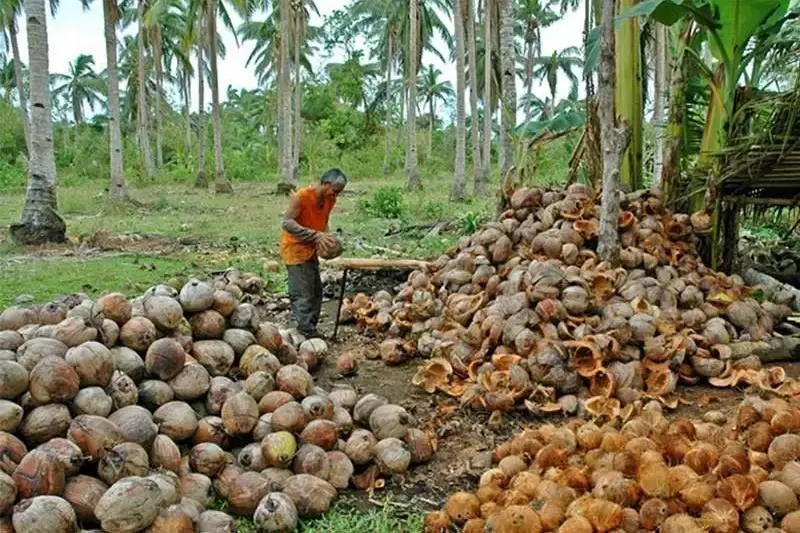
Coconut oil production is overwhelmingly copra-based. The dry process involves drying coconut meat—by sun, kiln or hot-air drier—and then extracting the oil by expeller pressing or solvent extraction. Sun drying can take 7–14 days, kiln drying 4–5 days at 40–50°C, and hot-air drying around 10 hours at 80–90°C. These are not trivial process details. Drying method and moisture control determine the free fatty acid (FFA) trajectory of the copra and, ultimately, the refining loss the buyer absorbs.
The production base is structurally fragmented. Over 95% of world coconut production comes from smallholders, many on remote islands. In Indonesia, about 98% of the coconut plantation area is smallholder-owned, with average productivity of roughly 0.48–0.50 metric tonnes of copra per hectare per year—consistent with ageing trees and limited inputs. Indonesia’s copra production is forecast at 1.63 million metric tonnes in 2026/27, up just 10,000 tonnes year-on-year.
This fragmentation has commercial consequences. Quality control begins at the farmer and collector level, where coconuts are sorted into standard and non-standard categories. At the copra industry level, copra is classified into edible, regular and rejected grades. For buyers, that classification is the first quality gate in the chain—and the point at which a feedstock’s refining cost begins to diverge.
Copra Crushing and Crude Coconut Oil Production
The next link is crushing. Indonesia’s coconut supply chain splits at the collector stage: approximately 30% of volume flows to the copra industry and 70% to the coconut processing industry, with crude coconut oil (CCO) as the intermediate stage before refining.
Crushing economics are currently under pressure in Indonesia. Copra mills are running below capacity because smallholders are diverting whole coconuts into export channels rather than selling to domestic crushers. International buyers are paying enough for whole coconuts to outbid the value smallholders receive from domestic mills, and the shift is forecast to continue into 2026/27 unless effective domestic incentives are introduced to retain coconuts for processing.
The numbers illustrate the constraint. Indonesia’s copra crush is forecast at 1.59 million MT for 2025/26 and 1.6 million MT for 2026/27, against installed capacity that processed 1.585 million MT in 2024/25. Coconut oil production is forecast at 1.04 million MT in 2026/27—an increase of just 5,000 MT year-on-year. Mill utilisation has slipped and is now contingent on the very price signal driving the diversion: only a softening in whole-coconut export prices is expected to return raw material to the mills.
For procurement teams, this is a supply-security issue, not only a price issue. A country with ample plantation area can still have constrained crush throughput if raw material is diverted upstream. Supplier qualification should therefore extend to the crusher’s feedstock access, not just the refinery’s nameplate capacity.
Refining: The Quality and Contaminant Control Gate
Crude coconut oil moves to refining—degumming, neutralisation or physical pretreatment, bleaching and deodorisation—to become RBD coconut oil. This is where the variable feedstock is converted into a specified functional ingredient. It is also where contaminant control becomes a supplier-qualification issue: high-temperature deodorisation can generate 3-MCPD and glycidyl esters, and buyers in regulated markets should require a certificate of analysis that addresses these parameters alongside FFA, moisture and colour.
The refining step is the supply chain’s main quality gate, but it is not a substitute for upstream discipline. A refinery can reduce FFA and colour, but it cannot recover yield lost to poor copra handling. Buyers who specify refining outcomes without auditing upstream copra quality are effectively asking the refinery to correct a problem that originated on the farm.
Packaging and Bulk Logistics: Where Physical Properties Meet Infrastructure
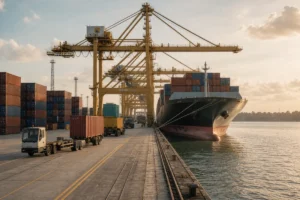
Coconut oil’s temperature-dependent melting behaviour makes logistics a specification issue. The oil is liquid at warm ambient temperatures and becomes cloudy, viscous or solid as temperatures fall. A shipment loaded liquid in Indonesia can arrive at a cooler destination requiring heating and extended unloading time if the receiving facility is not equipped for it.
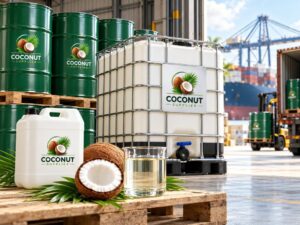
Three bulk packaging formats dominate export trade. Flexitanks carry 20–22 MT per container and are installed inside a standard 20-foot container. IBC tanks offer approximately 1,000-litre food-grade capacity, suited to medium-volume and specialty-grade shipments. HDPE or steel drums, typically 200-litre and sealed and stackable, serve smaller lots and destinations where flexitank discharge infrastructure is unavailable.
Temperature management is the operational priority. Best practice for RBD coconut oil in bulk is to maintain a storage range of 30–35°C during transit, using thermal blankets or heating pads in colder regions and keeping the product away from direct sunlight and moisture. Coconut oil starts to thicken around 25°C and hardens between approximately 21°C and 14°C, which means the choice between flexitank, IBC and drum is a heating and liability decision, not only a price decision. Drums are easier to heat individually in cold-climate destinations; a 22 MT flexitank requires the receiving facility to have heated discharge capability.
Documentation is the other logistics gate. Standard export sets include the Commercial Invoice, Packing List, Bill of Lading, Certificate of Origin and the Indonesian Export Declaration (PEB), with MSDS, Certificate of Analysis and additional certificates as required by the destination market. In practice, documentation gaps at destination are a more common cause of delay than vessel space.
Global Distribution and the Policy Layer
Coconut oil trade is concentrated. Supply originates in tropical Asia-Pacific—the Philippines, Indonesia and India—while major import demand is centred in the United States and the European Union. Trade flows are shaped by weather sensitivity in key origins, substitution with palm kernel oil, and quality variability driven by copra handling and refining specifications.
The policy layer is increasingly material. The Philippines’ B3 biodiesel blending mandate requires domestic fuel blenders to include coconut-based biodiesel, and a larger share of output continues to supply domestic industrial and food use, including biodiesel blending. Philippine coconut oil exports are projected at 1.19 million metric tonnes in 2026/27, up from 1.13 million tonnes, but volumes remain below 2024/25 levels precisely because domestic absorption is rising. USDA notes that a larger share of production is being absorbed locally for industrial and food uses, reinforced by biodiesel blending under the B3 mandate.
This means regional trade flows are increasingly governed by national retention and value-addition policies rather than pure export demand. A buyer comparing FOB quotations from two origins is not comparing like-for-like supply risk: one origin may face a domestic mandate that absorbs volume irrespective of export price.
Traceability and Sustainability: The Emerging Supply-Chain Requirement
Traceability has moved from a premium-market differentiator to a structural supply-chain requirement, particularly for European destinations. The EU relies heavily on coconut oil imports from Southeast Asia for food, cosmetics and oleochemicals, but access is increasingly restricted by mandatory food safety standards, voluntary sustainability certifications and due diligence obligations under the EU Deforestation Regulation.
The obstacle is structural. Smallholder fragmentation in Indonesia—which produced 646,000 tonnes of coconut oil in 2023—remains the primary barrier to meeting EUDR plot-level traceability requirements. Evidence from Indonesian exporters shows an operational gap among small and medium exporters characterised by basic batch-level tracking, early-stage EUDR awareness and heavy reliance on processing partners. While coconut is not yet officially on the EUDR mandatory list, pressure on the supply chain is already growing, and the focus for 2026 is shifting toward offline-first traceability tools for village collectors and hub-and-spoke models where lead processors act as digital managers for smallholder clusters.
A further commercial signal: EU demand is shifting toward processed and value-added coconut oil, which rose from 33% of imports in 2019 to 46% in 2023. Traceability and sustainability compliance are becoming essential conditions for securing premium market share, not optional add-ons.
Procurement Checklist for Supply-Chain Due Diligence
- Qualify the crusher’s feedstock access, not only the refinery. In Indonesia, whole-coconut export arbitrage can constrain crush throughput even when plantation area is ample. Ask how the supplier secures copra or whole coconuts and whether domestic diversion risk is managed.
- Map the quality gates from farm to port. Copra classification at the industry level is the first gate; refining is the last. A supplier that can document quality control at both ends is better positioned to deliver consistent specification than one that only tests the finished oil.
- Match packaging to destination infrastructure. Flexitank is the cost-efficient bulk format, but it requires the receiver to have heating and discharge capability for solidified oil. Confirm destination handling before fixing packaging, and confirm the supplier’s recommended handling temperature.
- Treat domestic policy as a supply-risk variable. The Philippine B3 mandate and Indonesia’s downstreaming ambitions both affect export availability. Build origin diversification and contractual volume protection into supply plans.
- Verify traceability depth, not just certification claims. Ask for origin data, chain-of-custody documentation and the verification standard used where sustainability claims are made. EUDR readiness is a supplier capability question, not a marketing statement.
- Confirm documentation completeness before shipment. The standard export set plus MSDS, COA and destination-specific certificates should be agreed at contract stage, not discovered at the port.
Frequently Asked Questions
What is the first step in the coconut oil supply chain?
Copra production. Coconuts are harvested, the kernel is dried by sun, kiln or hot-air methods, and the dried copra is pressed or solvent-extracted to produce crude coconut oil. Copra quality and drying discipline determine the FFA and refining loss downstream.
Why is Indonesia’s copra crush constrained despite large plantation area?
Because smallholders are diverting whole coconuts into export channels rather than selling to domestic mills. International whole-coconut prices outbid what domestic crushers can pay, leaving mills underutilised. Indonesia’s copra crush is forecast at 1.59–1.6 million MT, with coconut oil production rising by only 5,000 MT year-on-year.
How is bulk coconut oil shipped internationally?
The dominant formats are flexitanks (20–22 MT per container), IBC tanks (approximately 1,000 litres) and 200-litre HDPE or steel drums. Temperature management is critical because coconut oil thickens around 25°C and hardens at lower temperatures; best practice is to maintain 30–35°C during transit.
What documentation is required for Indonesian coconut oil exports?
A standard set includes Commercial Invoice, Packing List, Bill of Lading, Certificate of Origin and the Indonesian Export Declaration. MSDS, Certificate of Analysis and destination-specific certificates such as Halal or phytosanitary are added depending on the market and application.
What is the EUDR and why does it matter to coconut oil buyers?
The EU Deforestation Regulation imposes due diligence and traceability obligations on commodities placed on the EU market. Coconut is not yet on the mandatory list, but pressure is growing and European buyers are already requesting plot-level traceability. Smallholder fragmentation in Indonesia is the primary structural obstacle to meeting those standards.
How long does it take for replanting to affect supply?
Indonesia has a coconut replanting programme covering 5,000 to 10,000 hectares planned for 2026, managed by the Plantation Fund Management Agency. USDA estimates these initiatives may begin to stabilise copra supplies in three to eight years—a long-cycle remedy for a short-cycle problem.
Conclusion
The coconut oil supply chain is not a single pipeline. It is a sequence of gates—copra quality, crush economics, refining control, packaging capability, policy exposure and traceability depth—and a weakness at any one gate surfaces as a commercial problem at another. A buyer who qualifies only the refinery is underwriting risks that originate on the farm and in national policy.
The structural features of the chain are unlikely to change quickly. Smallholder dominance, ageing trees, competition for whole coconuts and domestic retention policies will continue to shape export availability. What buyers can control is the depth of their due diligence: knowing where the copra comes from, how the crusher secures feedstock, how the refinery controls contaminants, and how the shipment will behave at the destination port.
PT Bonanza Megah is an established Indonesian coconut oil manufacturer with a history dating back to 1972, supplying coconut oil and specialty fats to international markets. Buyers mapping supply-chain risk for crude or RBD coconut oil can engage the company’s export team on origin, specification, packaging and documentation requirements.
Looking for a reliable coconut oil manufacturer and supplier from Indonesia? Contact PT Bonanza Megah to discuss your product requirements and bulk supply inquiries.