The global coconut oil industry is entering a phase defined less by cyclical price swings and more by structural recalibration. Production is recovering from recent weather-driven setbacks, yet the industry’s underlying capacity remains constrained by ageing trees, fragmented smallholder supply and a long replanting cycle that no price signal can shorten. At the same time, demand is diversifying—food manufacturing continues to absorb the largest share, but oleochemicals, medium-chain triglyceride (MCT) applications and bio-based chemistry are creating new demand pools with different specification profiles.
For procurement managers and industrial buyers, the strategic question is not whether coconut oil will remain available. It is what kind of industry will supply it by the end of the decade, and what that means for grade availability, traceability obligations and contractual risk. This analysis examines the forces shaping the industry’s trajectory and the implications for international buyers.
Production Recovery Meets a Structural Ceiling
The 2025/26 season delivered a genuine supply recovery. Global coconut oil production rose by approximately 7%, driven by favourable rainfall in the Philippines, and global stocks rebuilt accordingly. Prices fell sharply—at one point trading around 30% below the record high of the previous June.
That recovery, however, is not the beginning of a looser market. Production growth is forecast to decelerate to around 1% in the 2026/27 season, even as global consumption is projected to rise by 3–4%. The International Coconut Community’s outlook placed 2026 production at approximately 3.025 million metric tonnes, with exports forecast at 2.678 million metric tonnes—a recovery from 2025 but still below the 2024 level.
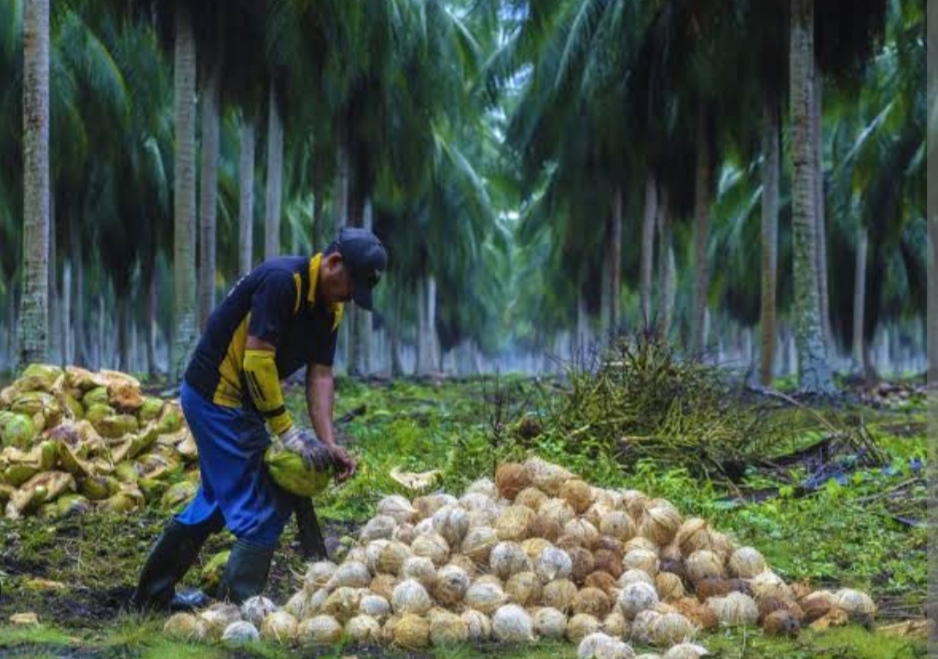
The deceleration is structural, not incidental. Coconut oil production depends on perennial trees with gestation periods measured in years, and the smallholder base that supplies over 95% of world output has limited capacity to invest in productivity improvements without sustained support. USDA projections for 2026/27 place world production at 3.82 million metric tonnes, up 3.5% year-on-year—a figure that indicates stabilisation rather than expansion.
The critical variable is weather. Severe dryness linked to El Niño conditions began in the Philippines in 2026, and analysts expect major supply contraction and market tightness to take effect from mid-2027 onward. A recovery that took one good rainfall season to deliver can be reversed by a single poor one. For buyers, the supply outlook is best characterised as a plateau with downside weather risk, not a return to surplus.
The Demand Mix Is Shifting Toward Higher-Value Applications
While aggregate demand growth appears modest at 3–4%, the composition of that demand is changing in ways that matter for grade availability and specification requirements.
The coconut derivatives market—a broader category encompassing oil, milk, water, desiccated coconut and fibre—is projected to grow from USD 28.95 billion in 2025 to USD 50.90 billion by 2031, at a CAGR of 9.88%. The MCT oil segment, which relies on coconut-derived medium-chain triglycerides, is forecast to grow from USD 4.08 billion in 2025 to USD 8.93 billion by 2034, at a CAGR of 9.10%. Coconut oil retained a 75.60% share of the MCT feedstock market in 2025, supported by consumer perception and established supply chains across the Philippines, Indonesia and India.
This shift has a specific grade implication. MCT production, sports nutrition, ketogenic formulations and functional food manufacturing require refined, consistent feedstock—typically RBD or specially fractionated coconut oil—not crude. The FDA’s “Generally Recognized as Safe” approval for MCT oils in 2024 removed a regulatory hurdle and accelerated their use in bakery, confectionery, beverages and meal-replacement products. The demand growth is therefore concentrated in the higher-value end of the grade spectrum, tightening the market for the grades that food manufacturers already prefer.
Oleochemical demand adds a second layer of competition. Coconut fatty acids are positioned at the intersection of renewable chemistry, personal care innovation and resilient supply-chain strategy, with customers increasingly prioritising bio-based performance ingredients. Limited lauric oil supplies are expected to maintain upward pressure on mid-cut fatty alcohol values into 2026. The consequence is that food manufacturers and oleochemical producers are drawing on the same lauric feedstock pool, and the allocation between them will be determined by price and contractual priority rather than by end-use hierarchy.
Replanting Is the Industry’s Long-Cycle Bet
Both major origins have recognised that ageing trees are the binding constraint. The Philippines has doubled its 2026 replanting target to 50 million coconut trees, part of a five-year plan to plant 100 million trees by 2028, alongside a PHP 1.8 billion fertilisation programme aimed at raising average yields from around 40 nuts per tree annually to at least 60.
Indonesia’s programme is smaller in scale and faces a distinct constraint. Its replanting efforts are limited by a seed bottleneck that imposes a supply ceiling measured in decades, and by a “replanting poverty trap”: farmers cannot afford the income gap during the years before new trees bear fruit. Unlike oil palm, for which a replanting subsidy of Rp 60 million per hectare exists, coconut has no equivalent income support, and roughly 90% of Philippine coconut farmers live below the poverty line.
For buyers, the replanting story is a reminder that supply responsiveness is structurally slow. A tree planted in 2026 will not contribute materially to commercial output until the early 2030s. In the interim, yield improvement through fertilisation and better agronomy is the only lever that can lift output meaningfully, and that lever depends on sustained investment and farmer participation.
Traceability Is Becoming a Condition of Market Access
The most consequential change in the industry’s commercial architecture is the shift from anonymous, mass-balance trade to traceable, segregated supply. Coconut is not yet formally on the European Union Deforestation Regulation’s mandatory list, but the pressure on the supply chain is already growing, and the industry is moving quickly to prepare.
The operational implications are significant. The traditional mass-balance model—which allowed compliant and non-compliant oil to be blended—is no longer sufficient under strict 2026 benchmarks. Processors must pivot to Identity Preserved or Segregated supply chains, physically separating shipments and tracing them to specific farms. Processors also bear legal responsibility for data errors in the EU system, a high-stakes obligation that the market may not yet be willing to subsidise.
The structural obstacle is that over 95% of world production comes from smallholders, many on remote islands without smartphones or formal land titles. Asking these farmers to provide high-tech geospatial polygons risks a “digital blockade” that severs their connection to global trade. The industry’s response is shifting toward offline-first traceability tools for village collectors and hub-and-spoke models in which lead processors act as digital managers for smallholder clusters. A “traceability premium” shared by buyers is increasingly discussed as the mechanism to fund transparency without pushing the cost onto farmers.
Compliance is becoming a condition of premium market access rather than an optional differentiator. EU demand is shifting toward processed and value-added coconut oil—from 33% of imports in 2019 to 46% in 2023—and traceability and sustainability compliance are essential to securing that share. Unprepared suppliers face a high barrier to entry, while early adopters gain a competitive advantage in the segments where margins are highest.
Policy Divergence Is Reshaping Trade Flows
The two dominant origins are pursuing opposite strategies, and the divergence is shaping global availability.
The Philippines has positioned coconut as a national priority, targeting USD 3 billion in exports by 2026 through a combination of replanting, fertilisation and processing investment. Indonesia has taken a contrasting approach, imposing export taxes on whole coconuts to encourage domestic value-added processing. The policy aims to transform Indonesia from a raw material exporter into a finished goods manufacturer, capturing more value from the supply chain. The short-term effect, however, is to constrain the raw material available to domestic crushers and to divert whole coconuts into export channels where international buyers outbid local mills.
The Philippines’ B3 biodiesel blending mandate adds a domestic absorption layer that further limits export availability. A larger share of Philippine production continues to supply domestic industrial and food use, including biodiesel blending, and exports are projected at 1.19 million metric tonnes—below the structural peak of 1.67 million tonnes.
For international buyers, the practical consequence is that origin diversification is no longer sufficient on its own. Two origins may both be “available” in a given season while facing different policy-driven retention pressures. Supply contracts need to account for the risk that national policy, not price, determines whether a cargo is exported.
What the Future Industry Means for Procurement Strategy
The industry’s trajectory points toward a market that is structurally tighter, more regulated and more differentiated by grade and provenance than the one buyers have known.
Supply security will command a premium over spot price. In a market where production growth is decelerating, weather risk is elevated from 2027 onward, and policy can redirect volumes without notice, the lowest quotation is not a reliable indicator of delivered supply. Buyers with qualified alternate suppliers and contractual volume protection are better positioned than those who purchase opportunistically.
Grade specification will need to reflect the competitive demand for refined material. RBD and fractionated grades are the feedstock for the fastest-growing applications—MCT, functional foods, non-dairy and infant nutrition—while oleochemical demand competes for the same lauric pool. A procurement plan that assumes RBD availability can be taken for granted, or that crude can be substituted without reformulation, is exposed to this tightening.
Traceability capability will become a supplier-qualification criterion. Whether the destination market is European retail, U.S. food manufacturing or intra-Asian trade, the direction of travel is toward documented origin, chain of custody and verification against credible standards. Suppliers with established traceability infrastructure and a track record of working with smallholder clusters will be better positioned to serve premium buyers than traders assembling cargoes from multiple mills.
Replanting and yield investment will separate long-term suppliers from short-term participants. A manufacturer with an established plantation-to-refinery chain, a history of operating through multiple market cycles and a demonstrated capacity to invest in upstream productivity is a different counterparty from a trading house that sources opportunistically. In a structurally tight market, that difference becomes a supply-risk variable.
Frequently Asked Questions
Is coconut oil production growing or shrinking?
It is recovering but decelerating. Production rose about 7% in 2025/26, driven by favourable rainfall in the Philippines, but growth is forecast to slow to roughly 1% in 2026/27 even as consumption rises 3–4%. USDA projects 3.82 million metric tonnes in 2026/27, up 3.5% year-on-year—a stabilisation rather than a return to surplus.
What is the biggest risk to coconut oil supply in the next few years?
Weather. Severe dryness linked to El Niño began in the Philippines in 2026, and major supply contraction and market tightness are expected from mid-2027 onward. The recovery of 2025/26 can be reversed by a single poor rainfall cycle, and ageing trees limit the industry’s capacity to buffer that risk.
Why is traceability becoming so important in coconut oil trade?
Because market access is increasingly conditional on it. Coconut is not yet formally on the EUDR mandatory list, but EU buyers are already requiring plot-level traceability, and the traditional mass-balance model is no longer sufficient under 2026 benchmarks. Processors must move to Identity Preserved or Segregated supply chains, and suppliers without that capability will be excluded from premium segments.
How are Indonesia and the Philippines’ policies affecting export availability?
They are pursuing opposite strategies. The Philippines is investing in replanting and fertilisation to expand supply, while a domestic biodiesel mandate absorbs a growing share of output. Indonesia is taxing whole-coconut exports to force domestic processing, which constrains the raw material available to its own crushers and diverts coconuts into export channels. Both policies limit export availability relative to a pure market-clearing outcome.
What demand segments are growing fastest for coconut oil?
MCT and functional food applications are growing fastest in value terms. The MCT oil market is forecast to nearly double from USD 4.08 billion in 2025 to USD 8.93 billion by 2034, with coconut oil holding a 75.6% feedstock share. Oleochemical demand for lauric fatty acids and alcohols is also structurally strong, and both segments compete for the same refined feedstock that food manufacturers require.
Will replanting solve the supply constraint?
Not quickly. The Philippines aims to plant 50 million trees in 2026 and 100 million by 2028, but new trees take years to reach commercial productivity. Indonesia faces a seed bottleneck and a replanting poverty trap that limits farmer participation. Replanting is a long-cycle investment whose effect will be felt in the early 2030s, not in the current procurement cycle.
Conclusion
The future of the global coconut oil industry is not a story of abundance returning. It is a story of a structurally constrained supply base meeting a demand mix that is shifting toward higher-value, higher-specification applications, under a regulatory environment that is making traceability a condition of trade. The industry that emerges will be more transparent, more differentiated by grade and provenance, and less forgiving of suppliers who cannot document where their oil came from.
For procurement managers, the implication is to treat coconut oil as a strategically managed category rather than a commodity purchase. Secure supply through qualified counterparties with upstream depth. Specify grade against function and recognise the competitive pressure on refined material. Build traceability into supplier qualification before it becomes a contractual prerequisite. And plan for a market where weather risk from 2027 onward is a material variable, not a footnote.
PT Bonanza Megah is an established Indonesian coconut oil manufacturer with a history dating back to 1972, supplying coconut oil and specialty fats to international markets. Buyers planning supply for the coming cycle can engage the company’s export team on grade, specification, traceability documentation and long-term supply requirements.
Looking for a reliable coconut oil manufacturer and supplier from Indonesia? Contact PT Bonanza Megah to discuss your product requirements and bulk supply inquiries.